Last Updated: October 25, 2026
Quick Summary
The steps to take after motorcycle accident in Florida begin with moving to safety and calling 911 immediately, then seeking medical attention, reporting the crash to law enforcement, collecting evidence and witness information at the scene, and contacting your insurance company with only factual details about what happened.
- Move to safety, turn on hazard lights, and call 911 even if injuries seem minor
- Accept medical transport and follow up with your doctor within days to document injuries
- Collect photos and video of vehicle damage, road conditions, injuries, and witness contact information
- Exchange the other driver’s full name, license number, vehicle details, and insurance policy number
- Report the accident to law enforcement if damage exceeds $500; Florida requires police to provide the crash report within 10 days
Table of Contents
- Immediate Actions: Safety and Emergency Response After a Motorcycle Accident
- Report the Crash to Law Enforcement and Obtain Your Crash Report
- Motorcycle Accident Checklist: Exchange Information and Collect Evidence
- Motorcycle Accident Evidence to Collect at the Scene
- What to Say to Insurance After a Motorcycle Accident
- Motorcycle Accident Settlement Timeline and Next Steps
- Florida-Specific Reporting Requirements and Comparative Fault Rules
- Connect With an Experienced Motorcycle Accident Attorney
- Frequently Asked Questions
Immediate Actions: Safety and Emergency Response After a Motorcycle Accident
The first moments after a motorcycle accident determine your safety and the strength of your legal claim, which is why knowing the steps to take after motorcycle accident in Florida is essential. Get yourself and others to safety, then call for emergency help, everything else depends on these first steps. Use a comprehensive first-hour checklist to ensure you take all critical steps in the immediate aftermath.
Move to a Safe Location
Your physical safety comes first. If you’re able to move, get yourself and your bike out of traffic and turn on your hazard lights. If you’re injured or suspect spinal or head injuries, stay where you are and wait for emergency responders.
Wave down approaching vehicles or use your phone’s flashlight to prevent a secondary collision. Once safe, assess yourself for bleeding, broken bones, or difficulty breathing, shock can mask pain.
Call 911 and Request Emergency Assistance
Call 911 immediately, even if injuries seem minor, motorcycle accidents often cause internal injuries that don’t show symptoms right away. Give the dispatcher your exact location, the number of injured people, and whether traffic is still flowing.
When paramedics arrive, describe your injuries clearly and mention any loss of consciousness or head impact, even with a helmet. Early medical documentation protects your legal claim later.
Accept Medical Help and Seek Prompt Medical Attention
Accept transport to the hospital, even if paramedics say you can refuse. Adrenaline masks pain, and internal bleeding, organ damage, and traumatic brain injury can develop after impact.
At the hospital, be specific about how the accident happened and report any symptoms, no matter how minor.
Follow up with your primary care doctor within a few days. Delayed-onset neck pain, back pain, or headaches are common, and a follow-up visit documents the progression of your injuries.
Report the Crash to Law Enforcement and Obtain Your Crash Report
A police report creates an official record of what happened, identifies the at-fault driver in most cases, and provides a case number for your insurance claim and any legal action.
If law enforcement did not arrive at the scene, file a report at your local police station or sheriff’s office with the other driver’s information and any photos or witness details.
Request a copy of the crash report for your insurer and any attorney you hire.
Motorcycle Accident Checklist: Exchange Information and Collect Evidence
The information and evidence you gather at the scene determines your ability to prove fault and recover compensation. Most victims make critical mistakes here, collecting too little detail or saying things that hurt their claim later.
Exchange Contact and Insurance Information
Get the other driver’s full name, phone, email, address, driver’s license number and state, and their vehicle’s make, model, color, and plate.
Do the same for any passengers in the other vehicle, they may be witnesses or file their own claims.
If the other driver is hostile, don’t argue, get what information you can and step away. Never admit fault or apologize; stick to facts like “I was traveling north on Main Street.”
Identify Witnesses and Collect Their Contact Details
Get the name, phone, and email of anyone who saw the accident. Ask what they observed, which vehicle was moving, direction, traffic lights, speed, without coaching or suggesting answers.
Write down their account while they’re talking, and ask them to text or email a written statement while details are fresh.
If someone refuses to give information, don’t push, note their appearance and location and give that detail to police, who may track them down through the crash report.
Motorcycle Accident Evidence to Collect at the Scene
Evidence collected immediately is far more valuable than evidence gathered days later, the scene changes, memories fade, and physical evidence disappears. Collect everything you can while you’re there.
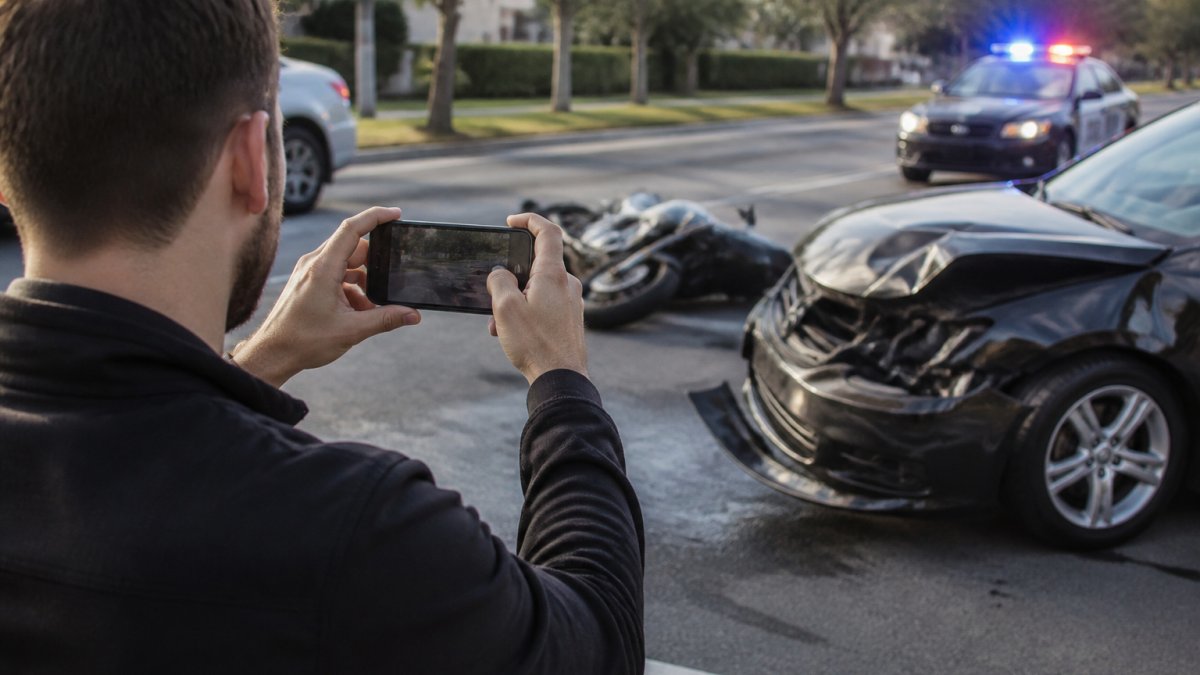
Photograph and Video the Scene, Vehicles, Injuries, and Damage
Take photos and video from multiple angles: damage to both vehicles, roadway conditions, traffic signals, street signs, skid marks, and debris.
Photograph your injuries at the scene and again over the next few days, bruises, road rash, and swelling often worsen. Document the progression with dated photos.
Video the scene while narrating what you see, the intersection, the traffic light, how the other vehicle hit you.
Photograph the other driver’s insurance card and license if they’ll let you; if they refuse, write the information down carefully.
Document Your Protective Gear and Physical Evidence
Photograph your helmet, jacket, gloves, and other protective gear.
Preserve your gear as evidence, never throw away a damaged helmet or jacket. Your attorney may want to show them to an expert or jury.
Collect debris from the accident scene if it’s safe to do so. A broken headlight lens, pieces of fairing, or fragments from the other vehicle all help establish what happened.
What to Say to Insurance After a Motorcycle Accident
Your first conversation with the insurance company sets the tone for your entire claim.
Call your own insurance company first, not the other driver’s. Your insurer has a duty to act in your interest.
Do not speculate about fault.
Do not accept a settlement offer immediately. The adjuster may call within days with an offer.
Provide medical records and repair estimates when asked, but do not volunteer information beyond what the adjuster requests.
Motorcycle Accident Settlement Timeline and Next Steps
The timeline from accident to settlement varies widely depending on injury severity, fault clarity, and whether litigation becomes necessary. Understanding the typical progression helps you set realistic expectations.
Most insurance claims settle within 30-90 days for straightforward accidents with clear liability and minor injuries.
Serious injuries or disputed fault can extend the timeline to 6-12 months or longer.
Throughout this timeline, keep detailed records of all expenses: medical bills, lost wages, travel costs to appointments, and any other accident-related expenses.
Florida-Specific Reporting Requirements and Comparative Fault Rules
Florida law imposes specific requirements on accident reporting and defines how fault is determined when both drivers share responsibility.
If the accident causes injury or property damage exceeding $500, you must report it to law enforcement.
Florida follows a comparative fault rule: if you are found to be partially at fault, your compensation is reduced by your percentage of fault (Chapter 768 Section 81 – 2026 Florida Statutes).
Insurance companies often try to assign you partial fault to reduce their payout. This is where evidence collection and witness statements matter.
Florida also has specific motorcycle insurance requirements. Motorcyclists must carry minimum liability coverage, but uninsured and underinsured motorist coverage is optional, and highly recommended.
Connect With an Experienced Motorcycle Accident Attorney
The steps to take after motorcycle accident in Florida shape your entire recovery process.
305-800-PAIN connects you with experienced legal professionals in Florida. Our team provides 24/7 support. Learn when to contact a lawyer personal injury cases require and understand how timing affects your case strength and compensation potential.
Our network of attorneys can assist with various aspects of your claim, including investigating the accident, negotiating with insurance companies, and pursuing litigation if necessary. Understand how a personal injury lawyer in Florida can help you recover by guiding you through the legal process and fighting for fair compensation.
The lawyers we refer work on a contingency fee basis, meaning you typically pay nothing unless they win your case. This allows you to get legal help without worrying about upfront costs.
| Step | Timeline | Key Action |
|---|---|---|
| Immediate | 0-10 minutes | Move to safety, call 911, accept medical help |
| First 24 hours | Day 1 | Seek medical attention, document injuries, collect scene evidence |
| First week | Days 2-7 | File police report, contact insurance, preserve evidence |
| First month | Weeks 2-4 | Follow up with medical care, gather documentation, consult attorney |
| Claim phase | 1-6 months | Exchange information, negotiate settlement, pursue litigation if needed |
Getting the right legal representation early protects your recovery and removes the stress of navigating insurance claims alone. Learn about proving fault in a motorcycle accident and understand the evidence needed to build a strong case.
Frequently Asked Questions
What are the first steps to take immediately after a motorcycle accident?
Move yourself and your motorcycle to a safe location if possible, then call 911 to report the accident and request emergency assistance. Accept medical help from first responders, even if you feel fine, some injuries develop over hours or days. Do not leave the scene. Notify law enforcement and cooperate with their investigation. Your immediate priority is safety and medical care before anything else.
What motorcycle accident evidence should I collect at the scene?
Photograph and video the entire scene from multiple angles, including vehicle damage, road conditions, traffic signals, and your injuries. Document your protective gear to show what you were wearing. Collect the other driver’s name, phone number, address, driver’s license number, license plate, vehicle make and model, and insurance information. Get names and contact details from all witnesses. Take photos of street signs, mile markers, and weather conditions. This evidence preserves your claim and protects you in settlement negotiations.
What should I say to insurance after a motorcycle accident?
Report the accident to your insurance company promptly, but keep your statement brief and factual. Stick to what you observed: time, location, road conditions, and what happened. Do not admit fault, speculate about what the other driver was thinking, or discuss your injuries in detail. Say: ‘I was in an accident. I have injuries and am seeking medical care. I will provide more details once I have seen a doctor and reviewed the police report.’ Let your attorney handle detailed discussions with insurance adjusters.
How long does a motorcycle accident settlement typically take?
Settlement timelines vary widely depending on injury severity, liability clarity, and insurance company responsiveness. Simple cases with clear fault may settle in 2-4 months. Complex cases involving serious injuries, disputed liability, or multiple parties can take 6-18 months or longer. Your attorney will negotiate with the insurance company, and you must reach maximum medical improvement before accepting a settlement. Do not rush into a low offer early in the process.
What happens if I don’t report my motorcycle accident to police within a certain timeframe?
Florida law requires drivers involved in accidents causing injury, death, or property damage over $500 to report the crash to law enforcement. Failure to report can result in criminal charges, license suspension, and civil liability. Report the accident as soon as possible, ideally at the scene. If you leave before police arrive, contact the local police department to file a report within 24 hours. A police report is critical evidence for your insurance claim and any legal action.
Should I accept the first settlement offer from the insurance company?
No. Insurance companies often make low initial offers hoping you will accept quickly. Do not settle until you have fully recovered or reached maximum medical improvement, which can take months. Work with an experienced motorcycle accident attorney who understands your injuries, medical expenses, lost wages, and pain and suffering. Your attorney will negotiate on your behalf and advise you when a fair settlement has been reached. Accepting too early means losing compensation you are legally entitled to.
What is comparative fault in Florida, and how does it affect my motorcycle accident claim?
Florida follows comparative fault rules, meaning you can recover damages even if you are partially at fault, as long as you are less than 51% responsible for the accident. If you are found 40% at fault and the other driver 60% at fault, you can recover 60% of your damages. Your recovery is reduced by your percentage of fault. This is why evidence collection and witness statements are critical: they establish who caused the accident and protect your right to compensation.